
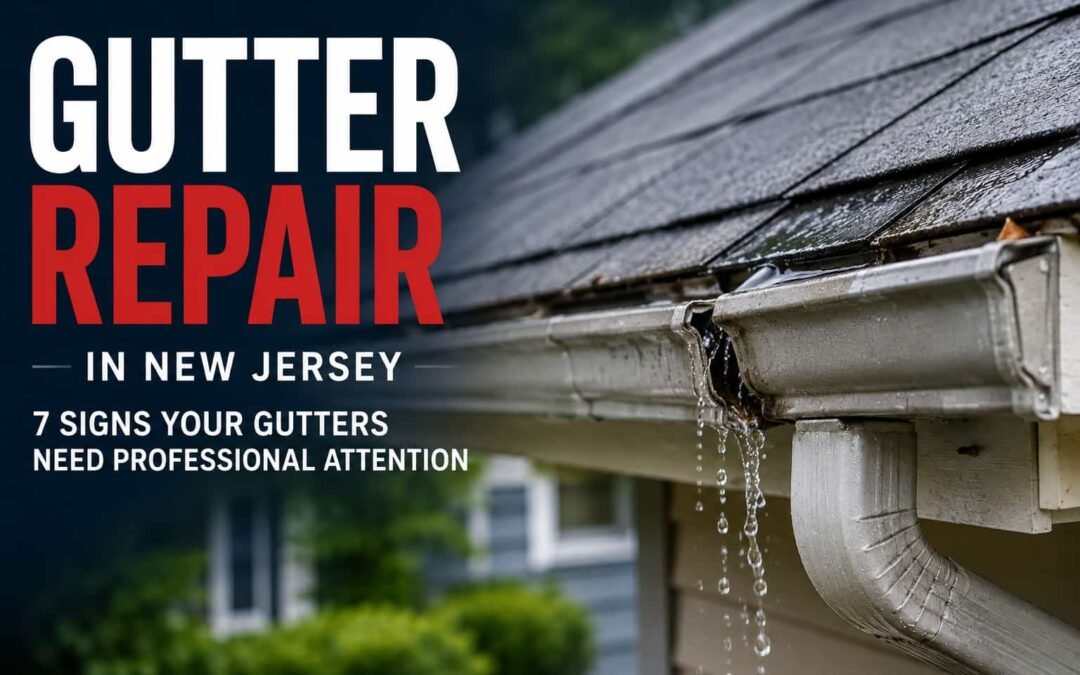
A damaged gutter system doesn’t always need to be completely replaced. Problems such as isolated leaks, loose hangers, minor sagging, damaged downspouts, or separated sections may be repairable when they are identified early and the rest of the system is still in good condition.
For New Jersey homeowners, recognizing the early signs of gutter problems can help prevent rainwater from reaching areas where it can damage fascia, siding, landscaping, and areas around the home’s foundation.
The important question isn’t simply whether your gutters look old. It’s whether they can still collect roof runoff and move it safely away from your home.
Why Gutter Problems Shouldn’t Be Ignored
Your gutters are part of your home’s exterior water-management system.
When rain falls onto the roof, the gutter system collects that water and directs it through downspouts toward designated discharge areas.
When one part of that system fails, water may end up somewhere it wasn’t intended to go.
You might notice:
- Water running over the gutter
- Leaks around seams or corners
- Water stains on exterior surfaces
- Gutters pulling away from the fascia
- Soil erosion below the roofline
- Water collecting close to the house
- Sagging gutter sections
Some of these problems can be relatively straightforward to repair. Others can indicate that the existing system has larger drainage or structural issues.
Here are seven signs that it’s time to have your gutters professionally inspected.
1. Water Is Leaking From Gutter Seams or Corners
A small leak may not look particularly serious during light rain.
During a heavy New Jersey storm, however, even a relatively small failure can allow a significant amount of water to escape the gutter system.
Leaks commonly develop around:
- Seams
- End caps
- Corners
- Outlets
- Connections
- Previously repaired areas
An isolated leak doesn’t necessarily mean you need entirely new gutters.
If the surrounding gutter is structurally sound, a professional may be able to address the affected area.
However, if leaks continue appearing in multiple locations, it may indicate that the gutter system has deteriorated beyond the point where repeated repairs make financial sense.
2. Your Gutters Are Pulling Away From the House
A gutter should remain securely attached along the roofline.
If you notice sections pulling away from the fascia, don’t ignore them.
Possible causes include:
- Loose or failed hangers
- Excessive debris weight
- Standing water
- Improper installation
- Ice and winter weather
- Deteriorated fascia
- Physical damage
The underlying cause matters.
Simply pushing the gutter back into position without determining why it separated may only provide a temporary solution.
If the fascia itself has deteriorated, that condition may also need to be addressed before the gutter can be securely reattached.
3. Your Gutters Sag in the Middle
Sagging is one of the easiest gutter problems to see from the ground.
A gutter that visibly dips between attachment points may not drain properly.
Water can collect in the low area instead of flowing toward the downspout.
That additional weight can make the sagging worse over time.
A professional inspection should determine whether the problem involves the gutter itself, hangers, pitch, fascia, or another installation issue.
Localized sagging may sometimes be repairable.
Severe or widespread sagging can be an indication that replacement should be considered.
4. Your Gutters Overflow Even When They’re Clean
This is one of the most important gutter problems homeowners misunderstand.
An overflowing gutter isn’t necessarily a clogged gutter.
If the gutters and downspouts are clean but water still pours over the edge during heavy rain, the system may have another problem.
Possible causes include:
- Incorrect gutter pitch
- Insufficient gutter capacity
- Too few downspouts
- Restricted outlets
- Poor downspout placement
- Large roof areas draining into small gutter sections
- Concentrated runoff from roof valleys
This is why repeatedly cleaning an overflowing gutter doesn’t always solve the problem.
The entire drainage system needs to be evaluated.
5. Water Is Running Behind the Gutters
Water should enter the gutter—not travel behind it.
If you notice water stains, wet fascia, peeling exterior finishes, or water running between the gutter and the house, professional inspection is recommended.
Several conditions can contribute to water getting behind a gutter, including gutter positioning, installation issues, roof-edge conditions, deterioration, or other exterior components.
The source should be identified before recommending a repair.
Replacing or resealing a gutter without correcting the underlying cause could allow the problem to continue.
6. Your Downspout Isn’t Draining Properly
Gutters receive a lot of attention, but downspouts are equally important.
A gutter can collect rainwater perfectly and still fail if that water cannot leave the system efficiently.
Signs of a possible downspout problem include:
- Gutters overflowing near the outlet
- Water backing up during rain
- Water leaking from downspout connections
- Damaged or disconnected sections
- Water dumping directly beside the foundation
- Visible blockages
Downspouts should not only carry water downward—they should help move that water to an appropriate discharge area.
That final part is important.
A functioning gutter system that dumps large quantities of water directly beside the house may simply be moving the problem from the roofline to the ground.
7. You’re Constantly Paying for Gutter Repairs
Occasional maintenance or an isolated repair is normal.
Repeated repairs are different.
If you’re fixing one leak this year, another section next year, and sagging gutters shortly afterward, it may be time to compare the cost of continued repairs against replacement.
This doesn’t mean old gutters automatically need to be replaced.
Instead, evaluate the system as a whole.
Ask:
Are these isolated problems—or is the gutter system progressively failing?
That’s a much better way to make the repair-versus-replacement decision.
Gutter Repair vs. Gutter Replacement: Which Do You Need?
Not every damaged gutter needs replacement.
Use this comparison as a starting point:
| Gutter Condition | Repair May Be Appropriate | Replacement May Be Better |
|---|---|---|
| One leaking seam | ✓ | |
| Loose hanger | ✓ | |
| Minor sagging in one area | ✓ | |
| Damaged downspout section | ✓ | |
| Isolated connection problem | ✓ | |
| Multiple recurring leaks | ✓ | |
| Severe sagging across multiple areas | ✓ | |
| Extensive deterioration | ✓ | |
| Multiple failing sections | ✓ | |
| Incorrectly sized system | ✓ | |
| Repeated overflow despite repairs | Inspect first | Possibly |
| Gutters repeatedly separating from home | Inspect first | Possibly |
This table is only a general guide.
The condition of the gutter, fascia, roofline, downspouts, and overall drainage design should be evaluated before deciding between repair and replacement.
Can a Leaking Gutter Be Repaired?
Often, yes.
An isolated leak may be repairable when the gutter material around the damaged area remains in good condition.
The bigger concern is why the leak developed.
For example, repairing one leaking seam won’t solve a gutter that constantly holds standing water because its pitch is incorrect.
Likewise, sealing a problem area won’t solve an undersized system that regularly overflows during heavy rainfall.
Effective gutter repair should address the cause—not merely hide the symptom.
Why Does My Gutter Hold Water After It Rains?
A small amount of residual moisture isn’t necessarily unusual, but significant standing water should be investigated.
Potential causes include:
- Improper pitch
- Sagging
- Loose hangers
- Blocked outlets
- Debris accumulation
- Structural movement
Standing water adds weight to the system and may contribute to additional stress.
During New Jersey winters, water remaining in gutters can also be exposed to repeated freezing and thawing.
Should I Repair or Replace Old Gutters?
Age alone shouldn’t determine the answer.
Consider three things:
Condition
Are there isolated problems, or is deterioration widespread?
Performance
Do the gutters successfully manage water during heavy rain?
Repair Frequency
Are you addressing one minor problem, or have repairs become routine?
If an older system is structurally sound and functioning properly, replacement may not be necessary simply because of its age.
If multiple components are failing, replacement may offer a more practical long-term solution than continuing to repair individual sections.
What Happens If Damaged Gutters Aren’t Repaired?
Water doesn’t disappear when a gutter stops working.
It simply goes somewhere else.
Depending on the property and severity of the problem, uncontrolled roof runoff may contribute to:
- Fascia deterioration
- Exterior staining
- Soil erosion
- Landscape damage
- Water accumulation around the home
- Premature gutter deterioration
- Problems around entryways and walkways
That’s why early inspection is usually preferable to waiting until the gutter is visibly failing.
A Better Way to Diagnose Gutter Problems
Instead of asking only:
“Where is the gutter leaking?”
A professional evaluation should ask:
“Why is the gutter leaking?”
A proper inspection may evaluate:
- Overall gutter condition
- Attachment to the fascia
- Gutter pitch
- Seams and corners
- Outlets
- Downspout condition
- Downspout placement
- Areas of concentrated roof runoff
- Water discharge around the property
- Evidence of recurring overflow or standing water
This broader approach helps distinguish a simple repair from a larger drainage problem.
Frequently Asked Questions About Gutter Repair
How do I know if my gutters can be repaired?
Localized leaks, loose hangers, minor separation, and individual damaged components may be repairable when the rest of the gutter system remains in good condition. Multiple failures or extensive deterioration may make replacement more practical.
Why do my gutters overflow in heavy rain?
Clogs are one possible cause, but overflow can also result from insufficient gutter capacity, poor pitch, inadequate downspouts, restricted outlets, or concentrated roof runoff.
Is a sagging gutter repairable?
Minor localized sagging may be repairable depending on the gutter, hangers, fascia, and cause of the problem. Extensive sagging should be professionally evaluated.
Should leaking gutters always be replaced?
No. An isolated leak doesn’t automatically require complete replacement. The decision should depend on the location and cause of the leak and the overall condition of the gutter system.
Can damaged gutters affect my home’s foundation?
Gutters are designed to help direct roof runoff away from the house. When water repeatedly overflows or is discharged too close to the home, it can contribute to excessive water accumulation and soil erosion around the foundation area.
Professional Gutter Repair in New Jersey
When gutters start leaking, sagging, overflowing, or separating from your home, don’t assume complete replacement is automatically necessary.
The first step should be determining what is causing the problem.
Jar Gutter Services provides residential gutter services and can inspect your existing system to determine whether a targeted repair or gutter replacement is the more appropriate solution.
Addressing smaller gutter problems early can also help prevent them from developing into larger drainage issues.
Contact Jar Gutter Services
Need professional gutter repair in New Jersey or aren’t sure whether your gutters should be repaired or replaced?
Contact Jar Gutter Services to schedule an evaluation.
Office: 732-682-5451
Email: info@jargutterservices.com
Website: https://jargutterservices.com/