
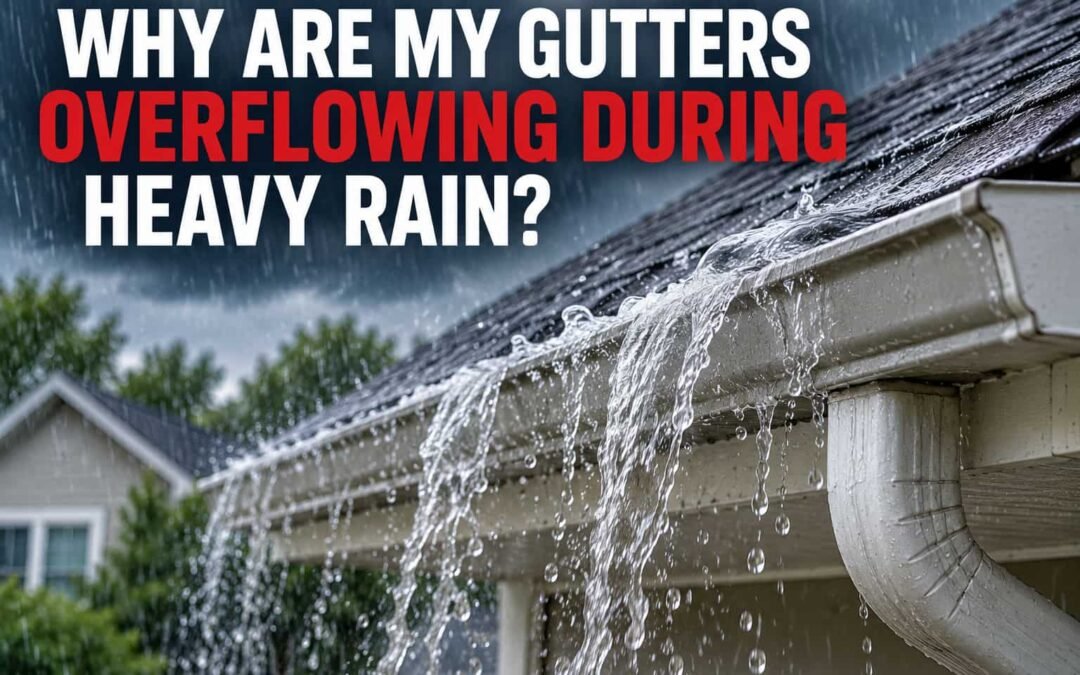
Gutters Overflowing in Heavy Rain
If your gutters overflow during heavy rain, a clog may be the problem—but it isn’t the only possible cause. Clean gutters can still overflow when they are improperly pitched, undersized for the roof, have insufficient downspout capacity, or receive concentrated runoff from large roof areas and valleys.
For homeowners, the important question isn’t simply “Are my gutters clean?”
It’s:
“Can my entire gutter system handle the amount of water coming off my roof?”
Understanding the difference can prevent you from repeatedly cleaning gutters when the actual problem requires a repair, adjustment, or redesigned drainage system. The U.S. Environmental Protection Agency (EPA) provides guidance on stormwater management and how runoff from developed surfaces can affect drainage systems.
Why Do Gutters Overflow?
Your gutter system has to perform two jobs quickly:
- Collect water coming off the roof.
- Move that water through the downspouts and safely away from the house.
If water enters the gutter faster than the system can discharge it, the gutter can overflow.
The cause may be as simple as leaves blocking an outlet, or it may involve the design and capacity of the gutter system itself.
Here are seven potential causes.
1. Your Gutters or Downspouts Are Clogged
This is the first thing most homeowners think about—and for good reason.
Leaves, twigs, roofing debris, seeds, and other materials can accumulate inside gutters and restrict water flow.
The gutter itself may look relatively clean while the real blockage is located at the downspout outlet or farther down the downspout.
During light rain, water may still drain.
During a heavy storm, however, the restricted opening may not allow water to escape quickly enough.
Water then begins rising inside the gutter until it spills over the edge.
What should you look for?
Watch the gutters during rainfall from a safe location.
If one section fills while another drains normally, there may be a localized obstruction.
Never climb onto a roof or ladder during a storm to investigate the problem.
2. Your Gutters May Be Too Small
This is where gutter diagnosis becomes more interesting.
A completely clean gutter can still overflow.
If the volume of roof runoff exceeds the gutter system’s capacity, water may spill over even when nothing is blocking it.
Residential properties commonly use different gutter sizes, including 5-inch and 6-inch systems.
But selecting gutter size shouldn’t be based solely on what is commonly installed in the neighborhood.
Several factors can influence drainage requirements:
- Roof area
- Roof configuration
- Roof pitch
- Number of downspouts
- Downspout size
- Location of roof valleys
- Areas where runoff becomes concentrated
- Local rainfall conditions
A larger or more complex roof may require greater drainage capacity than a smaller, simpler roof.
3. You Don’t Have Enough Downspout Capacity
Think about your gutter as a highway and the downspouts as the exits.
The gutter can collect a tremendous amount of water, but that water still needs somewhere to go.
If the outlets and downspouts cannot discharge water quickly enough, water backs up inside the gutter.
Eventually, it overflows.
This is why installing larger gutters without evaluating the downspouts doesn’t necessarily solve the problem.
A properly designed system needs sufficient capacity from beginning to end:
Roof → Gutter → Outlet → Downspout → Discharge Area
Every component matters.
4. Your Gutters Have the Wrong Pitch
Gutters need to guide water toward their outlets.
If a section is improperly pitched, water can collect instead of moving efficiently toward a downspout.
Signs of a possible pitch problem include:
- Standing water after rain
- Overflow concentrated in one area
- Water moving away from the downspout
- Repeated debris accumulation in low areas
- Visible sagging
Simply cleaning the gutter won’t correct an installation or pitch problem.
The gutter may need to be professionally evaluated and adjusted.
5. A Roof Valley Is Sending Too Much Water Into One Area
This is an issue many generic gutter articles overlook.
A roof doesn’t always distribute water evenly.
Roof valleys can concentrate runoff from multiple roof surfaces into a relatively small section of gutter.
During moderate rain, the system may work perfectly.
Then a major storm arrives.
A large amount of water suddenly reaches one small area and shoots over the gutter.
This can make homeowners believe their entire gutter system is too small when the actual problem may be concentrated runoff at a particular location.
An experienced gutter professional should look at the roof—not just the gutters.
6. Your Gutters Are Sagging
Sagging can create low spots where water collects.
Instead of flowing smoothly toward the downspout, water pools in the sagging section.
As more rain enters the system, that section can overflow.
The additional weight of standing water can also place more stress on the gutter and its attachment points.
Sagging can result from several conditions, including:
- Loose or damaged hangers
- Improper spacing
- Debris weight
- Standing water
- Deteriorated fascia
- Physical damage
- Installation problems
Minor localized sagging may sometimes be repairable.
More extensive problems should be professionally evaluated.
7. The Problem May Be at Ground Level
Sometimes the gutters and downspouts work correctly—but the drainage problem continues after water reaches the ground.
For example, a downspout may discharge large amounts of water directly beside the house.
Homeowners may notice:
- Soil erosion
- Mulch washing away
- Puddles near the home
- Water collecting around walkways
- Repeatedly saturated areas
That means the gutter system may be successfully moving water off the roof but failing to direct it to an appropriate discharge location.
The complete water-management system should therefore be considered—not just what happens at the roofline.
How to Diagnose an Overflowing Gutter
Here’s a simple troubleshooting framework:
| What You Notice | Possible Cause | What Should Be Checked |
|---|---|---|
| Overflow everywhere | Heavy debris or inadequate capacity | Gutters, sizing and downspouts |
| Overflow in one location | Local blockage or roof valley | Outlet and roof configuration |
| Overflow near downspout | Restricted outlet/downspout | Downspout |
| Standing water after rain | Pitch or sagging problem | Gutter alignment |
| Clean gutters still overflow | Capacity/design issue | Gutter and downspout sizing |
| Water goes behind gutter | Installation/roof-edge issue | Gutter positioning and roof edge |
| Water pools near house | Discharge problem | Downspout termination/drainage |
This is why diagnosing gutter overflow based on appearance alone can be misleading.
Are 6-Inch Gutters Better for Heavy Rain?
Not automatically.
Six-inch gutters provide greater capacity than comparable smaller gutters, which can be beneficial for some homes.
But simply installing larger gutters doesn’t guarantee the problem will disappear.
Imagine installing a larger gutter while keeping an inadequate drainage configuration.
You’ve increased how much water can be collected without necessarily addressing how quickly that water can leave the system.
The better question is:
Does the entire gutter and downspout system have sufficient capacity for the home’s roof and drainage conditions?
That’s what should determine the solution.
Why Do My Gutters Only Overflow During Very Heavy Rain?
This can be an important diagnostic clue.
If your gutters perform normally during light and moderate rainfall but consistently overflow during intense storms, the system may be approaching or exceeding its drainage capacity under high-flow conditions.
Potential factors include:
- Gutter size
- Downspout capacity
- Roof area
- Concentrated roof runoff
- Partially restricted outlets
- Pitch problems
Rather than assuming that occasional overflow is unavoidable, consider having the system inspected—especially if water repeatedly reaches areas you want to protect.
Can Overflowing Gutters Damage a House?
Repeated uncontrolled roof runoff can contribute to problems around a property.
Depending on where the water lands, you may see:
- Fascia deterioration
- Exterior staining
- Landscape erosion
- Mulch displacement
- Soil erosion
- Water collecting near the home
- Premature gutter deterioration
The severity depends on the property and where the water is going.
The purpose of the gutter system is not merely to stop water from falling from the roof.
It is to control where that water goes.
Should I Repair or Replace Overflowing Gutters?
That depends entirely on the cause.
Repair may be appropriate when:
- A downspout is blocked
- An outlet needs attention
- A localized section is sagging
- A hanger has failed
- A minor pitch issue can be corrected
- One component is damaged
Replacement or system modification may make more sense when:
- The gutters are significantly deteriorated
- Multiple sections are failing
- The existing system is improperly sized
- Overflow continues despite repeated repairs
- The system doesn’t provide adequate drainage capacity
Don’t replace gutters solely because they overflow.
First determine why they’re overflowing.
What Should a Professional Gutter Inspection Include?
A useful inspection should evaluate more than leaves and debris.
A gutter professional may need to examine:
- Gutter condition
- Gutter size
- Gutter pitch
- Hangers and attachment points
- Outlets
- Downspout size and placement
- Potential obstructions
- Roof configuration
- Roof valleys and concentrated runoff
- Water discharge around the property
Looking at the entire system provides a much better picture than examining one overflowing section in isolation.
Frequently Asked Questions
Why are my gutters overflowing if they’re completely clean?
Clean gutters can overflow when the gutter or downspout system doesn’t have sufficient capacity, the pitch is incorrect, outlets are restricted, or large amounts of roof runoff are concentrated into one location.
Will installing bigger gutters stop overflowing?
Larger gutters can increase capacity, but they aren’t automatically the solution. Downspouts, outlets, roof configuration, pitch, and discharge conditions should also be evaluated.
Why does only one corner of my gutter overflow?
Localized overflow can be associated with an obstruction, low spot, nearby roof valley, outlet problem, or another condition concentrating water in that area.
Can I fix overflowing gutters myself?
Basic debris removal may resolve some clogs, provided it can be performed safely. Recurring overflow, sagging, pitch problems, or suspected capacity issues are better evaluated professionally.
Should gutters ever overflow during heavy rain?
An unusually intense storm can challenge drainage systems, but gutters that repeatedly overflow during heavy rainfall should be inspected to determine whether maintenance, repair, or a system-capacity issue is involved.
Stop Treating the Symptom—Find the Cause
When homeowners see water pouring over their gutters, the first reaction is usually:
“They need to be cleaned.”
Sometimes that’s exactly right.
But when clean gutters repeatedly overflow, continuing to clean them won’t solve an underlying sizing, pitch, downspout, or drainage problem.
The better approach is to evaluate the complete path the water follows—from the roof all the way to where the downspout releases it.
If your gutters are overflowing, leaking, sagging, or failing to manage rainwater properly, Jar Gutter Services can inspect your gutter system and determine whether maintenance, repair, replacement, or another gutter solution is appropriate.
Contact Jar Gutter Services
For professional gutter repair, gutter replacement, and gutter installation in New Jersey, contact Jar Gutter Services.
Office: 732-682-5451
Email: info@jargutterservices.com
Website: https://jargutterservices.com/
gutters overflowing in heavy rain gutters overflowing in heavy rain gutters overflowing in heavy rain gutters overflowing in heavy rain gutters overflowing in heavy rain gutters overflowing in heavy rain gutters overflowing in heavy rain gutters overflowing in heavy rain gutters overflowing in heavy rain gutters overflowing in heavy rain gutters overflowing in heavy rain gutters overflowing in heavy rain gutters overflowing in heavy rain gutters overflowing in heavy rain gutters overflowing in heavy rain gutters overflowing in heavy rain gutters overflowing in heavy rain gutters overflowing in heavy rain gutters overflowing in heavy rain
gutters overflowing in heavy rain | gutter drainage problems | heavy rain gutter problems